Dr. Schick has now retired, and would like to thank his patients for their support over the years.
Varicose Veins - Causes & Symptoms
How Sclerotherapy Works
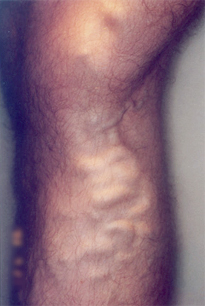
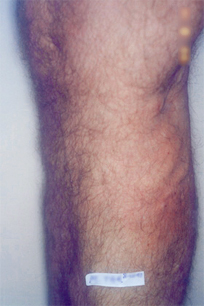
Varicose Veins (male patient) Before & After Treatment
at Schick VeinCare
What are Varicose Veins?
Varicose Veins are enlarged veins that are swollen and protruding above the surface of the skin, typically found in the backs of calves or inside of the legs. They may look like twisted cords. Their color can be flesh-colored, bluish or purple. Varicose Veins can cause tiredness, heaviness, cramps, itching, aching, throbbing, or burning sensations in the legs. There may be a dull ache with larger Varicose Veins that becomes worse after prolonged standing, but pain is not necessarily a symptom.
What Causes Varicose Veins?
Veins contain one-way valves designed to keep blood from flowing back in the wrong direction. A weakened valve may fail, allowing blood to leak back and pool in the vein, a problem called Venous Insufficiency. This added blood volume puts pressure on the vein walls, stretching them wider and enlarging them so that some valves no longer can close. The result is a Varicose Vein. As the vein is stretched out in length, it twists and forms tortuous shapes.
The pooling blood in the Varicose Vein puts higher pressure on other valves as well, causing them to fail and creating a series of compromised valves. These damaged blood vessels are no longer working efficiently in bringing blood back towards the heart, and so the circulatory system relies on alternate veins to transport the blood. Treatment of the diseased veins will result in improved circulation.
Who Gets Varicose Veins?
Both men and women can have Varicose Veins. The condition may be hereditary, perhaps related to weakness in the valves of the veins. Age can play a part also, causing loss of elasticity in the vein walls. The hormonal changes of menopause or hormone therapy relax vein walls as well.
Pregnancy & Varicose Veins
The increased pressure on leg veins due to the added blood volume during pregnancy, combined with relaxation of vein walls as a result of pregnancy's hormonal changes, can cause Varicose Veins to form. By three months after delivery, these have usually improved. Subsequent pregnancies, however, sometimes increase the number of abnormal veins.
Sclerotherapy at Schick Vein Care
At Schick Vein Care, we use Sclerotherapy, an injection technique used since the 1930's, to inject Varicose Veins with a sclerosing solution, like saline. The medication irritates the injected veins, causing them to swell, stick together, and then close. This stops the blood flow and the veins form scar tissue, which the body reabsorbs. After a few weeks, the treated veins should be fading. The same veins will need to be treated again during a second and possibly a third appointment.
Cost of Treatment
Cost of treatment at Schick Vein Care Clinic can vary, depending on the patient's condition. You will be given an estimate during your initial consultation. Vein treatment consists of at least 2 to 3 separate Vein Treatment sessions.
What to Expect from Treatment
Spider Veins
Hand Veins
Vein FAQs
Photo Gallery (Before & After Pictures)